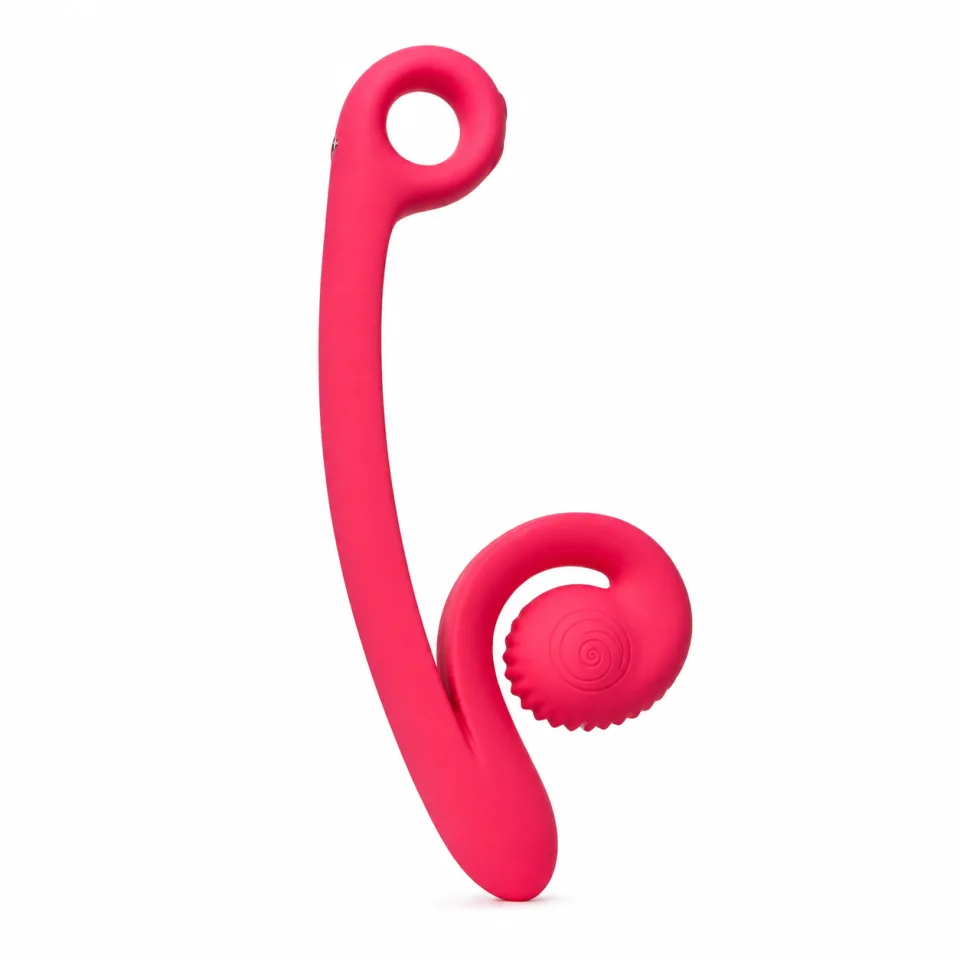
What draws me to SVibe is the thought behind that little rounded shell. Curve has a distinctive silhouette, yes, but the interesting part is that the shape has a job. Its external head is designed to move with the body while the handle gives you a separate place to hold it. That's the detail I'd start with if a friend asked why this particular design deserves a closer look.
I like products whose appearance makes more sense once you understand how they work. Curve belongs in that conversation. The moving head, curved body and separately controlled motors give me concrete reasons to be interested, well beyond a lovely colour on a product page.
The shell is the story
SVibe calls the moving-head mechanism Slide'n'Roll. In plain English, the external shell can move relative to the body of the product. The intention is to support continued external contact as the position changes.
To me, that's a thoughtful way to approach a dual-stimulation design. Rather than treating internal and external contact as two fixed points, the mechanism gives the external part some movement of its own. You can see why that detail comes up in demonstrations: it's much easier to understand when someone shows the shell moving than when you look at a front-facing photograph.
And it makes the silhouette rather satisfying. The rounded part isn't just there to give Curve its snail-like character. It's central to what the product is trying to do. I always appreciate that sort of connection between form and function, whether I'm looking at a well-cut bra or an object for the bedside drawer.
Two controls, more room for preference
The other feature I keep coming back to is independent motor control. Curve has one motor for each stimulation area, with separate controls. That means the two parts can be adjusted individually rather than treated as one setting.
I find that more interesting than a long list of modes. A number tells me there are options; separate controls tell me something about how those options can be used. You can focus on a single motor or combine both. The appeal is the freedom to choose a different balance, not an obligation to work through every available pattern.
There's a lovely simplicity to that. Plenty to explore, with a clear reason for each control. If I were comparing two designs, this is the feature I'd circle in my notes.
Curve and Gizi, side by side
The two models have a family resemblance, but I enjoy the fact that they aren't interchangeable ideas. SVibe presents Curve around movement and Gizi around a hands-free approach. That gives the choice a useful starting point: how would you like to handle the product?
| Design question | Curve | Gizi |
|---|---|---|
| What catches my attention? | The moving shell and distinct handle | The compact, rounded form |
| How does SVibe position it? | Contact that follows movement | Hands-free dual stimulation |
| Where would I begin comparing? | The handle and head movement | The flexible shape and placement |
I also like reading a person's description alongside those product details. Robyn's comparison for Lovense discusses the different shapes of Curve and Gizi. A comparison like that helps give a photograph some context: where the product curves, what looks flexible, and where the hand goes.
A customer's look at Snail Curve
A customer's experience with Snail Curve, shared on SVibe's channel.
Five details that make the design worth a look
1. A moving external head
This is Curve's defining feature for me. The articulation is a specific design choice with an understandable purpose. It gives you something useful to watch for in a demonstration.
2. Independent adjustment
Two motors with separate controls make the design adaptable in a very direct way. I like being able to understand the relationship between a button and the area it controls.
3. A recognisable place to hold it
The handle gives Curve a clear orientation. Looking at the product, I can distinguish the grip from the moving shell immediately. That makes its construction easier to read.
4. More than one configuration
The single-motor and combined-motor options add versatility without changing the object itself. I see that as an invitation to explore preferences, at whatever pace feels right.
5. A choice with personality
Curve and Gizi look different because their approaches differ. I appreciate a range where choosing a model means choosing a design idea, as well as a colour.
The small rituals count, too
A good place to keep the product, its charging cable within reach, a few minutes to read the care instructions: these are the quieter parts of choosing something for yourself. I like giving them a little attention. They make the object feel like it has a place in everyday life.
Our materials guide and lubricant guide are useful companions here. For the exact model, I'd keep its own instructions close by. The details are part of getting to know what you've chosen.
What stays with me about SVibe
It's the shell. After all the photographs and specifications, I come back to that one moving part and the thought behind it. Curve gives me a clear design story; Gizi offers another way to approach the same broad idea of dual stimulation.
For someone drawn to distinctive shapes and individual control, I think SVibe is well worth a look. I'd start with a demonstration of the movement, then spend a little time with the model that catches my attention. That's where this range gets interesting.